
Find a Giles County Property Owner
The cleanest path runs from address to parcel, parcel to assessment file, and owner name to recorded deed. Giles County's Commissioner of the Revenue describes parcel history files that can hold ownership details, deed and plat references, and prior owners. The public CAMA terms page does not list every owner field it displays. So work from the actual result. Do not assume the screen shows each address or sale detail. When you already have a name, search the Commissioner or SRA index and test each match against a parcel number or legal description. The newest deed is the recorded confirmation. A tax account adds payment context. But it never decides who the legal owner is.
- Find the address in Giles CAMA or InteractiveGIS and record the map number.
- Read the Commissioner's ownership information and note its January 1, 2026 data date.
- Search the most recent deed in SRA/COVERS and match the grantee and legal description.
- If an entity is named, use Virginia SCC filings as context, not as a substitute for the deed.
Giles County's Owner Data Date
The CAMA disclaimer states that displayed ownership data reflect January 1, 2026. That date is a snapshot, not a live feed. A deed recorded after it may show a newer transfer than the assessment file does. The same notice says in-year changes do not affect current billing. The Commissioner's official property records remain authoritative. This is the concrete reason to verify the latest deed. Check it after a purchase, inheritance, or transfer. The notice also stays silent on the live card's exact owner fields. It says nothing about result caps or export options. The Commissioner describes parcel history files in broad terms. So open the actual parcel result and read its labels. A missing field in a text-only description does not mean the office lacks the underlying record. The Giles CAMA notice supplies the date boundary.
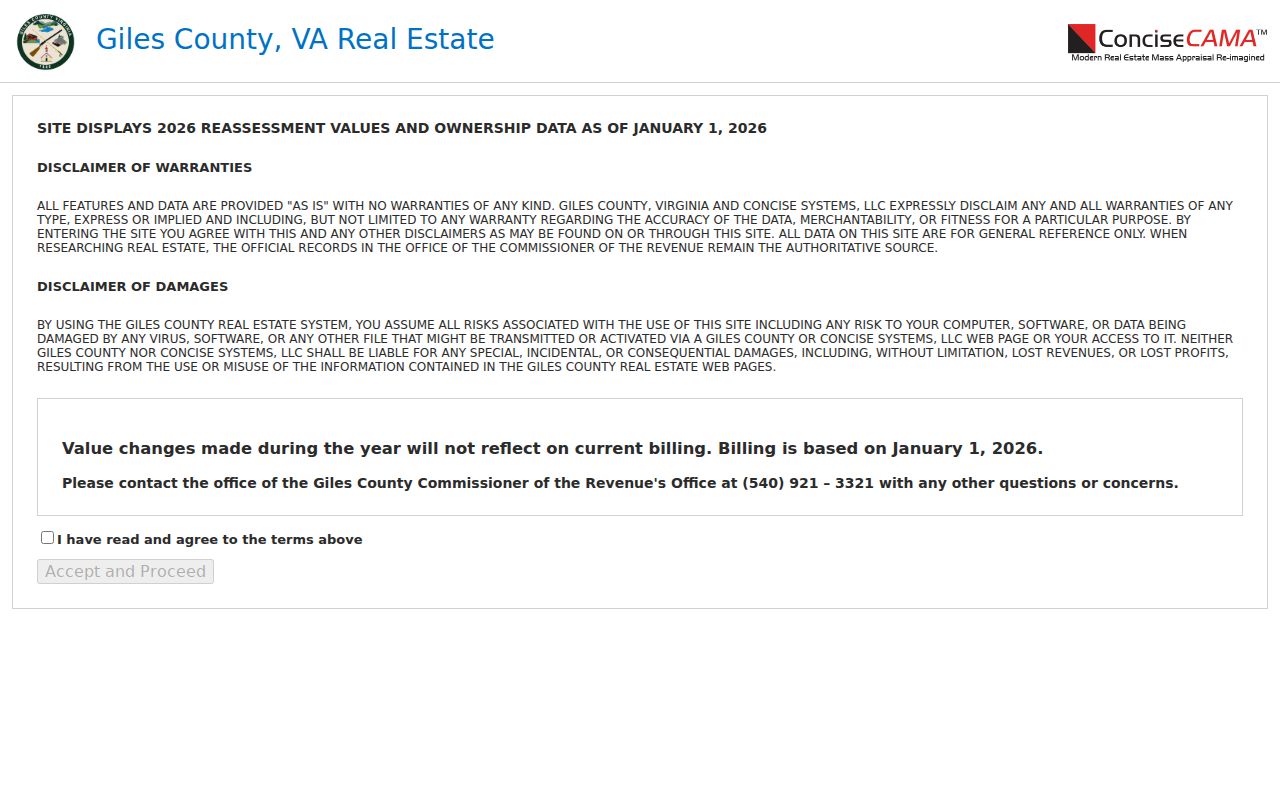
The CAMA terms page displays the system's use conditions; a live parcel record shows the owner information itself.
Confirm an Owner with the Giles Deed
Answering a current-owner question means comparing the Commissioner's parcel history with the newest recorded instrument. SRA/COVERS provides the remote index for Giles County deed records. The statewide rules allow index-only access in some courts. Images are limited to clerk-authorized subscribers. The county's local cutoff and field labels are not stated on the public pages. The image may be out of reach. If so, contact the Circuit Clerk with party names, a recording reference, or the legal description. Match the right tract with the deed's grantee and legal description. A recorded conveyance may name an LLC, a trustee, an executor, or several heirs. For earlier transfers, follow the Giles County deed index. The present-owner details are covered in the current owner record route. The official Virginia SRA/COVERS entry is the remote land-record search.
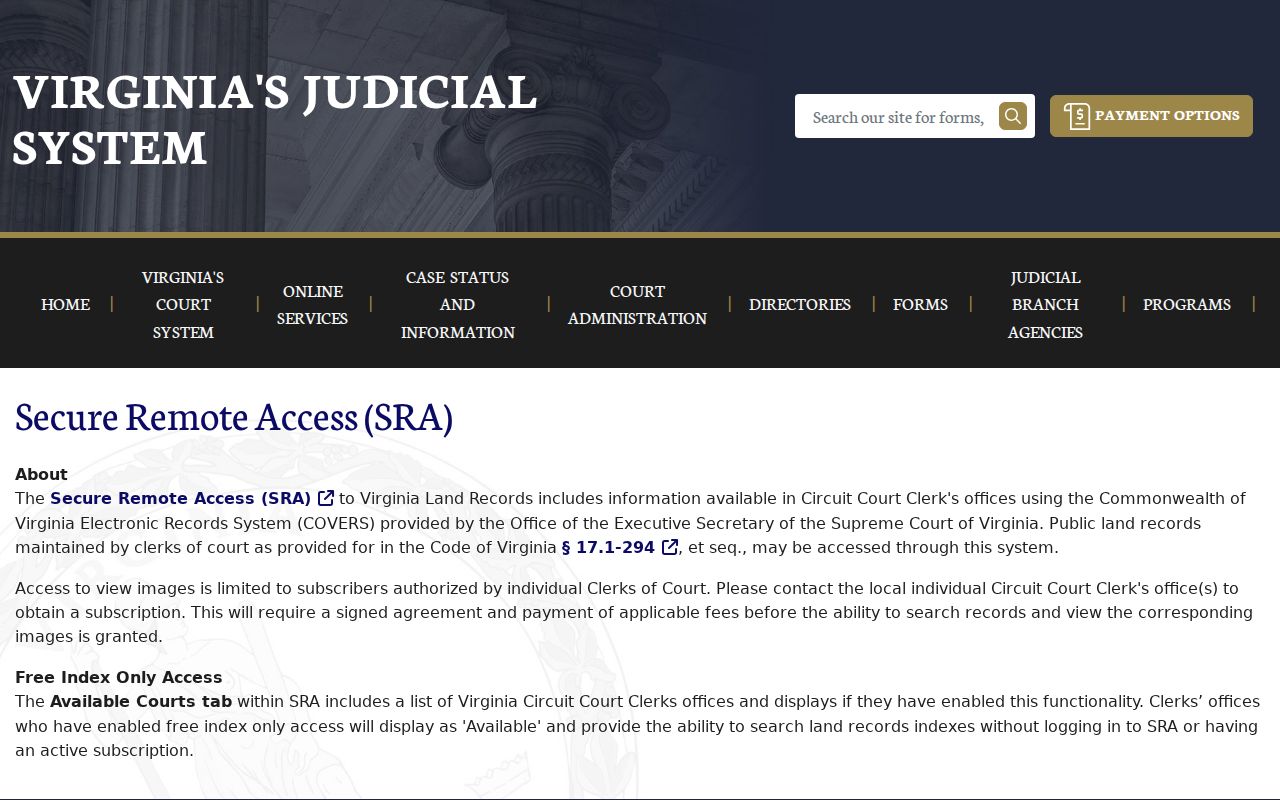
An index hit identifies the instrument; the clerk confirms image access and certified copies.
Names for Giles County Entities
The owner may be an LLC. In that case, search its exact legal name through the Virginia SCC Clerk's Information System. The SCC may show entity filings and a registered agent. That agent is not necessarily the occupant or a beneficiary. Treat the entity result as context. Then return to the recorded deed for the land transfer itself. Trusts can be indexed by trustee, trust name, or both. An estate may appear under "Estate of" or the personal representative. A life estate or retained interest can leave more than one person named in the instrument. Search spelling variants and initials, but never merge two names until the parcel and legal description agree. The official Virginia SCC entity system is a secondary source for company names.
Giles County Ownership Sources
Each Giles County record shows an owner from its own custodian's perspective. The Commissioner maintains ownership and parcel history. The Clerk records the conveyance. The Treasurer carries the tax account, and GIS supplies the map reference. Carry a name from one source to the others. Match it to the tract before treating it as the same property owner.
| Source | Owner Info It Gives | Access |
|---|---|---|
| Commissioner / CAMA | Ownership and parcel-history records | Free public reference; official file controls |
| Circuit Clerk / SRA | Recorded grantee and instrument | Index may be free; image access varies |
| Treasurer inquiry | Tax account and payment history | Free inquiry; not a title record |
| GIS / InteractiveGIS | Parcel geometry and map reference | Terms gate; not proof of legal ownership |
The listed owner is not always the person living at the property. Nor is it always the one paying the bill. A situs address marks the land. A mailing address tells where tax correspondence goes. Trust, estate, and company ownership can further separate the public record name from the person a neighbor knows. Giles County property records answer who an office associates with a parcel. They do not answer who occupies it.
Mailing and Situs in Giles Records
A situs address tells you where the land sits. A mailing address tells you where the county sends the tax bill. The two can differ without any transfer having occurred. A changed mailing line is not evidence that ownership changed. Rural routes and town mailing names often describe land lying outside the incorporated town too. Match the map number before reading anything into the mailing city. A notice may go to an agent, a trust, a company, or a post-office box. That address alone says nothing about who occupies or manages the parcel.
Record both address fields with their labels and the CAMA screen date. Compare the owner name and parcel description against the recorded deed. If an entity shows as owner, the Virginia State Corporation Commission search can identify the registered business name. Its listing is not proof that the business holds title to a particular tract. The deed and land record remain the property-specific sources.
Keep the distinction simple. A mailing address can fall outside Giles County or even outside Virginia. Field labels on the CAMA screen vary by display. Confirm the distinction on the actual record rather than assuming a mailing line appears in every result.
The owner name and address can sometimes seem to clash. Bridge the gap with the map number and legal description. A person can own rural land in one town's ZIP while getting mail somewhere else entirely. Postal city names never establish municipal jurisdiction. For a full current-owner check, trace the parcel through the Commissioner and the latest deed. Do not treat an address field as proof of occupancy.
Tax and Probate Clues to Ownership
A Treasurer account can link a map number to a billing history. A will or fiduciary record can explain why a deed chain runs through an estate. Neither one substitutes for the recorded conveyance. If a former owner has died, look for the probate instrument. Ask the Clerk about the wills and fiduciary indexes before treating a tax-card owner change as a complete inheritance record.
The Treasurer's inquiry helps when you need a bill or payment history. It does not prove who holds title. A payment may follow a closing, an estate arrangement, or a simple mailing instruction. For a deceased owner, Giles probate files can hold wills, fiduciary appointments, heir lists, and settlements. Those papers explain why a later deed comes from an executor or several heirs.
Search the last recorded owner in the Clerk's wills and fiduciary index. Do this when the chain appears to stop. The LVA catalog lists will books from 1806 through 1924. It also lists an index to wills and fiduciaries through 1976. Probate explains succession. The recorded deed still supplies the land-transfer reference. So never substitute a tax payment or a death record for the conveyance itself.
Limits of a Giles Owner Search
A Giles County ownership lookup has firm limits. It does not reveal who lives at a property. It does not prove every beneficial interest. It does not guarantee a title free of liens. Virginia law shields some addresses and records through specific confidentiality rules. Voter registration records in VERIS stay private under Va. Code § 24.2-404, and public voter lists omit protected addresses and other excluded fields. Property and voter data follow entirely different access rules.
Public records support lawful property research, a planned purchase, family-history work, and civic review. They are not a reason to contact or target anyone who has not invited contact. Verify suspicious letters through an official county phone number. Use the custodian to correct any record that appears wrong.
Lawful use. Use Giles County owner records for property research, due diligence, and civic transparency. Do not use a name or address to stalk, threaten, or harass anyone.